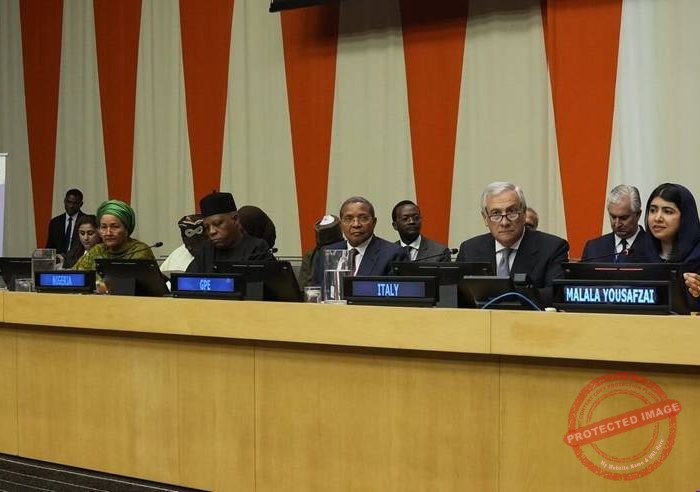
International resources mobilized by Italy, Nigeria and GPE alongside $471 billion in domestic financing to improve education for children in over 90 countries. New York City, September 23, 2026 — Global leaders rallied today behind the Multiply Possibility campaign at a high-level event convened by Italy, Nigeria and the Global Partnership for Education (GPE) at the UN General Assembly. The campaign aims to mobilize partnerships and financing for education as the world confronts a deepening learning crisis, with 270 million children and young people out of school. The financing announced today includes $2.1 billion in confirmed and anticipated pledges from sovereign and private donors to GPE, reaffirming confidence in GPE’s unique model and its ability to strengthen education systems, improve learning and deliver results at scale for children. The campaign also mobilized an initial $1.4 billion in co-financing, including $1 billion from development finance institutions and $400 million from a growing coalition of philanthropic and private sector partners. These resources can be leveraged alongside GPE grants, unlocking on average $4 in additional financing for every $1 of GPE resources and providing catalytic capital to partner countries at a time of mounting pressure on public budgets. Meanwhile, GPE partner countries announced $471 billion in domestic education financing commitments, a 32 percent increase in spending by 2030. They also made plans to use education budgets more efficiently, ensure resources reach the children with the greatest needs, and build resilience to shocks. GPE works with partner governments to sustainably increase domestic financing, so they can increasingly drive progress through national resources. “Quality education is the pathway to inclusive growth and lasting peace,“ said Nigerian President Bola Ahmed Tinubu, co-host of GPE’s Multiply Possibility campaign. “By funding the Global Partnership for Education, we empower dynamic and youthful nations like Nigeria to break down the barriers that keeps our children, especially our girls, out of school and away from learning, so they can achieve their full potential.” “Education is not a side chapter of development. It is the foundation upon which every other ambition is built — jobs, dignity, prosperity,” said Prime Minister Giorgia Meloni of Italy, co-host of GPE’s Multiply Possibility campaign. “Together, we have an opportunity to improve education for 750 million children by 2030. That is why Italy will double its contribution to GPE for the 2026-2030 cycle.” The high-level event was co-chaired by the Italian Deputy Prime Minister and Minister of Foreign Affairs and International Cooperation Antonio Tajani together with Vice President of Nigeria, Kashim Shettima. The Minister of Education of Nigeria, Dr. Tunji Alausa delivered closing remarks alongside Minister of Education and Merit of Italy, Giuseppe Valditara. The Multiply Possibility campaign comes at a time when many education systems are already underfunded and under strain from climate shocks, population growth, fragility and economic uncertainty. Lower-income countries face the urgent task of getting more children learning while equipping a new generation with the knowledge and skills to thrive in a world being reshaped by climate change and artificial intelligence. “Everything we value — health, peace, equality, opportunity — begins in a classroom,” said Malala Yousafzai, Nobel Peace Prize laureate and co-founder of Malala Fund. “GPE works precisely because of this partnership: countries pooling their resources to go farther than they could on their own.” The commitments made today provide an important foundation for GPE to begin turning its 2026-2030 strategy into results for children across partner countries, with more pledges to the campaign expected. “GPE shows what is possible when we act together. But today is not the end of our effort,” said Jakaya Kikwete, GPE Board Chair and former President of the United Republic of Tanzania. “We must keep mobilizing the political will, partnerships and resources needed to multiply possibility for every child, everywhere. If we fail to act, we fail a generation ready to learn and to lead.”
Meeting
Cum sociis natoque penatibus et magnis dis parturient montes
Press Statement
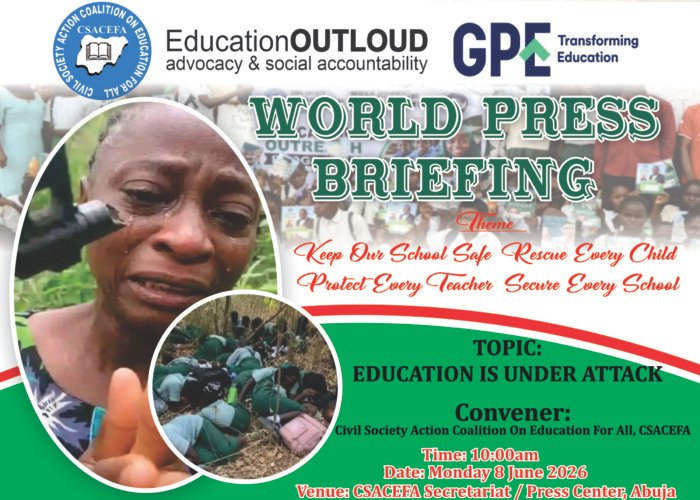
World Press Briefing on the Kidnapping of School Children in Oyo, Borno and Other Parts of Nigeria Delivered by the Civil Society Action Coalition on Education For All, CSACEFA Date: Monday, 8 June 2026 | Venue: Abuja, Nigeria Education is Under Attack: Keep Our Schools Safe, Rescue Every Child, Protect Every Teacher, Secure Every School Members of the press, distinguished partners, representatives of civil society, education stakeholders and fellow Nigerians, The Civil Society Action Coalition on Education For All, CSACEFA, convenes this press briefing in response to the disturbing and repeated kidnapping of school children, teachers and education personnel in Nigeria. As Nigeria’s national education coalition working on education advocacy, accountability, policy engagement and service delivery for basic and secondary education, we are deeply saddened, angered and alarmed by recent attacks on schools and school-related movements in Oyo State, Borno State and other parts of the country. Why This Moment Is Particularly Worrisome The recent attack in Ahoro Esinele community, Oriire Local Government Area of Oyo State, where at least 39 school children and seven teachers were reportedly abducted, including children from a secondary school and two primary schools, is a painful reminder that schools are becoming targets of violence. Reports also indicate that one teacher was killed in captivity and security operatives were wounded during a rescue attempt. Within the same period, suspected militants reportedly attacked Mussa Primary and Junior Secondary School in Askira-Uba Local Government Area of Borno State, where 32 students were reportedly abducted from the school and 10 others seized from nearby homes, bringing the reported number of missing pupils to 42. These incidents are not isolated. They form part of a growing pattern of attacks on education, where children, teachers, parents and school communities are made targets of fear, violence and trauma. For CSACEFA, this is not just another security incident; it is an attack on childhood, learning, families and Nigeria’s future. Nigeria has signed, endorsed and adopted international, regional and national commitments affirming every child’s right to safe, inclusive and quality education. Nigeria endorsed the Safe Schools Declaration on 29 May 2019 and has a National Policy on Safety, Security and Violence-Free Schools released by the Federal Ministry of Education in 2021. Yet children continue to be kidnapped, teachers targeted, schools closed and communities left in fear. This gap between policy commitment and children’s lived reality must end. This moment is even more troubling because the Government of Nigeria, together with the Government of Italy, is co-hosting the 2026 replenishment campaign of the Global Partnership for Education, GPE, which seeks to raise US$5 billion for the GPE Fund and mobilise US$10 billion in co-financing for education systems. Nigeria cannot stand on the global stage to mobilise education financing while, at home, children are being abducted from schools and parents are afraid to send children to classrooms. This is not a good narrative for Nigeria; it weakens our moral voice and undermines national credibility. The Trajectory of School Attacks and Kidnappings in Nigeria The kidnapping of school children in Nigeria did not begin in 2026. In April 2014, 276 schoolgirls were abducted from Government Girls Secondary School, Chibok, Borno State. Amnesty International reported in 2024 that 82 of the Chibok girls were still in captivity ten years after the abduction. Since Chibok, Nigeria has witnessed repeated school abductions in Dapchi, Kankara, Kagara, Jangebe, Afaka, Tegina, Bethel Baptist, Kuriga, Kebbi, Niger, Borno, Oyo and other communities. Available public reporting indicates that since 2014, at least 1,900 students from about 20 schools have been abducted. Amnesty International also warned in November 2025 that repeated abductions are putting a generation at risk, especially after 20,468 schools were reportedly closed across seven states following a major school abduction in Niger State. The crisis now cuts across regions: North-East, North-West, North-Central and South-West. It affects basic and secondary education; boys and girls; teachers, parents and entire communities. Attacks on education are spreading, deepening and becoming normalised. This normalisation must be rejected. Verified Snapshot of Major Incidents Year State / Region Reported Incident Reported Figure / Notes 2014 Borno / North-East Chibok Government Girls Secondary School 276 schoolgirls abducted; 82 reportedly still in captivity as of 2024. 2018 Yobe / North-East Dapchi Government Girls Science and Technical College 110 schoolgirls abducted. 2020-2021 Katsina, Zamfara, Kaduna, Niger Kankara, Jangebe, Afaka, Tegina, Bethel Baptist and others Hundreds of boys, girls, pupils, students and teachers abducted across basic, secondary and tertiary institutions. 2024 Kaduna / North-West Kuriga school community 227 pupils reported abducted, including 187 secondary and 40 primary pupils. 2025 Niger / North-Central St Mary’s School, Papiri 303 schoolchildren and 12 teachers reportedly abducted. 2026 Borno and Oyo Mussa Primary/JSS, Askira-Uba; Ahoro Esinele, Oriire LGA 42 pupils reported missing in Borno; 39 schoolchildren and seven teachers reportedly abducted in Oyo. Schools Must Be Safe Havens, Not Terror Zones Schools are supposed to be safe spaces where children learn, grow, dream and build their future. They are not places where children should be hunted, abducted, traumatised or killed. How many of these children will have the courage to return to school? How many parents will allow their children back into classrooms if government cannot guarantee safety? When schools become terror zones, parents lose trust, children lose confidence, teachers lose motivation and communities lose hope. Government must not allow the enemies of education to gain the upper hand. Human, Educational and Economic Impact School kidnapping destroys learning, worsens Nigeria’s out-of-school children crisis and deepens poverty. UNICEF states that about 10.5 million Nigerian children aged 5-14 years are not in school, while only 61 percent of children aged 6-11 regularly attend primary school and 35.6 percent of children aged 36-59 months receive early childhood education. Every attack pushes more children, especially girls, out of school. Abduction also causes fear, nightmares, anxiety, depression, withdrawal and learning difficulties for children, while parents and teachers carry lasting trauma. Families lose income, spend scarce resources searching for children or relocating, and communities are pushed deeper into insecurity. Stop Politicising
IMO STATE UNIVERSAL BASIC EDUCATION BOARD NOMINATES CSACEFA AS MEMBER PROJECT MONITORING COMMITTEE
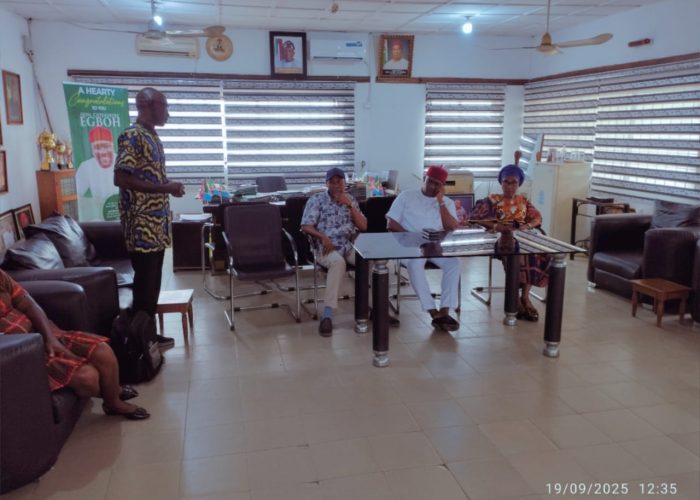
CSACEFA imo state, led by Elder Kenneth Amogu paid an Advocacy/courtesy visit to the Executive Chairman, IMSUBEB Hon Chief Chidiebere Egbo and Members of his Board, to officially inform them about the ongoing EDUCATION OUTLOUD (EOL) activities for 2025 at the state. CSACEFA team appreciated the board members for their appointment, the progress recorded in budgetary provision for Basic Education in the 2025 budget and for the existing collaboration between CSACEFA and IMSUBEB. The team informed the Board amongst other things, the forthcoming State Education Summit, the Gender Responsive Pedagogy Teachers Training, etc and again advocated for opportunity for CSACEFA to provide technical support to the board in the on going budget process, and in participating in Project Monitoring of Basic Education projects for inclusive Education of all, including the girl child and children from poor families. In his response the Executive Chairman Hon Chief Chidiebere Egbo, expressed amongst other things, his desire for the digitalization of education for swift capturing of data and relevant information for adequate planning, he requested that CSACEFA join the board 2026 Budget team and work with them, to provide the technical support to ensure that “cost for digitalization ” is captured in the 2026 budget proposal of the Board. On project monitoring, which will start in the next few weeks, the Executive Chairman personally nominated the State Coordinator (Male) into the Board Project Monitoring team and requested that the Director, NGO Desk of the Board, Dr (Mrs) Chinwe Adim Madumere to also nominate another representative ftom the Civil Society Organisations, and CSACEFA State Secretary (Female) was nominated. The Board members thanked CSACEFA for the supports and expressed their willingness to collaborate with CSACEFA in the year 2025 Education summit and other Project activities.#educationforallintheresponsibilityofall CSACEFA Imo State team today, also paid an Advocacy/Courtesy call to The Executive Secretary Secondary Education Management Board (SEMB), Lady Augustina Azubuike and members of her team to intimate them about CSACEFA Imo State ongoing EOL Project activities, and request for their continued support. The team advocated for increase in education funding for basic education and training of teachers. After the briefing from the State Coordinator, Elder Kenneth Amogu, the Executive Secretary, pledged the continued support of the Board especially for the forth coming GRPTT and the Education summit.
The secret of success is to do the common thing
Aliquam eu nunc. Nulla sit amet est. Nam at tortor in tellus interdum sagittis
Try hard not to become a man of real success
Aliquam eu nunc. Nulla sit amet est. Nam at tortor in tellus interdum sagittis
Stop chasing the money and start chasing the passion.
Aliquam eu nunc. Nulla sit amet est. Nam at tortor in tellus interdum sagittis
The successful warrior is the average man, with a laser
Aliquam eu nunc. Nulla sit amet est. Nam at tortor in tellus interdum sagittis